|
|
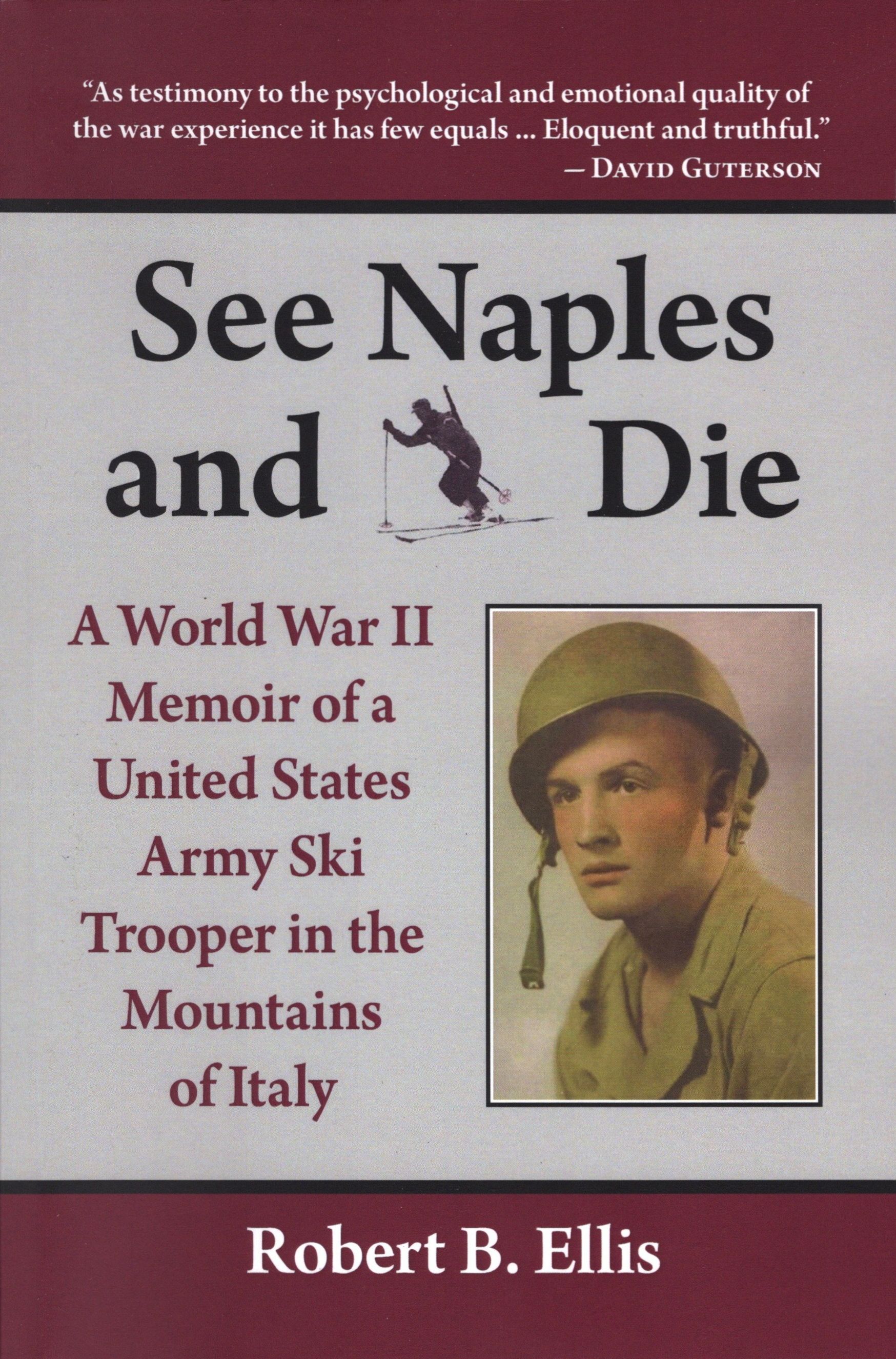
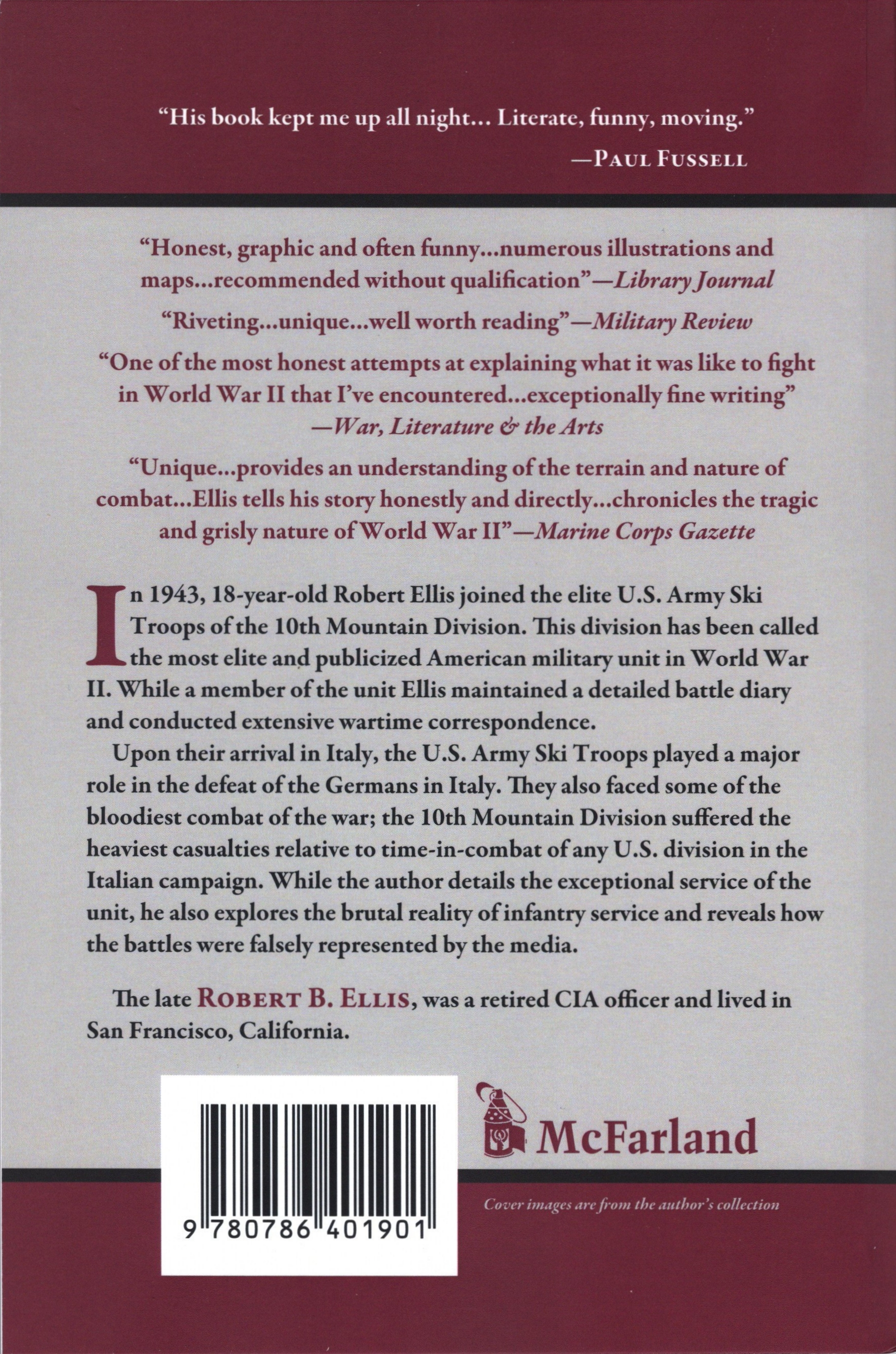
See Naples and Die: A World War II Memoir of a United States Army Ski
Trooper in the Mountains of Italy
FROM THE PUBLISHER
In the spring of 1943, the 18-year-old son of former medical missionaries
to Iran volunteered for service with the Ski Troops of what became the U.S.
Army's elite 10th Mountain Division. The 10th, which began its training
on Mt. Rainier, attracted some of America's greatest skiers and mountaineers,
and has been called the most publicized American army unit of World War
II. This book is a harrowing personal account of Robert Ellis' coming
of age in this unit which not only suffered five times more casualties
in training than any other American division in WW II, but also experienced
the heaviest losses relative to time in combat of any U.S. division in
the Italian campaign. Through hundreds of emotional and often bitter letters,
supplemented by detailed battle diary entries and connecting narrative,
Ellis writes with intimacy, candor, and self-deprecating humor about his
gradual maturation and accommodation to the many senseless brutalities
of military service and the horrors of ground warfare.
See Naples and Die is a story about the hopes, cynicism, and disillusionment
of a young soldier called to duty in the so-called "good war."
It is also a moving tribute to his ski-troop "band of brothers,"
his family who shared and responded to his letters, and the girl who gave
him much needed courage and support during those traumatic years far from
home. Unsparing in its honesty about war and human nature, in this narrative
not everyone emerges a hero all the time (including the author), and the
actions and judgment of commanders are questioned where appropriate, as
well as the conduct of some in the lowest ranks.
The memoir is often disarmingly funny, offering relieffrom the recounting
of the grim reality of training and the combat experience. At the same
time, Ellis makes clear through a myriad of examples how the institutionalized
carnage of infantry battle has been falsely represented by the media to
the public, and brings home to the reader the awful gap between those
who talk about wars and those who fight them.
FROM THE CRITICS
Marine Corps Gazette
"What makes the memoir unique is that it is told mostly in the words
of the young Ellis as he experienced it, recaptured in the hundreds of
letters he wrote his family during his service.... Bob Dole ... also served
in the 85th Regiment of the 10th Division-but a different battalion from
Ellis. Ellis' book, however, provides an understanding of the terrain
and nature of combat where Dole was wounded and nearly died.
Ellis tells his story honestly and directly, finding fault where he saw
it-including with himself. He is no fan of war and the military way of
life, neither as a young man, nor today. He chronicles the tragic and
grisly nature of World War II as he experienced it, and in the process
conveys a deep affection for his comrades in arms and the remarkable 10th
Mountain Division." (August 1998.)
Skiing Heritage
This account of World War II combat with the 10th Mountain is told by
retired CIA analyst Robert Ellis, a machine gunner in "the skiers'
division" during the three months it saw action in Italy in the winter
of 1945. . . . Dead men tell no tales and, in many tales by those of the
10th who came back, happy to survive, the reality of combat has been quickly
passed over. Ellis provides a long overdue correction..
The book has some of the better descriptions of combat to come out of
World War II and despite the fact that we know the outcome there is surprising
suspense to the narrative, a tribute to Ellis' writing and the freshness
and frankness of his material." (Fall/Winter 1996-97.)
James H. Meredith
During the past year and a half, I've been developing a casebook about
the literature of World War II. . . . In my readings, I discovered that
there are particularly a great many quality memoirs on World War II, but
only a handful of truly memorable ones: among those, . . . Robert B. Ellis'
See Naples and Die. Besides the exceptionally fine writing and demonstrated
literacy of the author, one especially noteworthy feature of this memoir
are the letters written to and from home. Through these letters, a sense
of Ellis' life and family shows through, and we are again and again reminded
that combatants do not alone suffer in war: loved ones back home suffer
as well.
This book is not only for readers and scholars interested in World War
II or twentieth-century combat, but also for those drawn to memoir and
autobiography as well." (War, Literature, and the Arts, Spring/Summer
1998)
Library Journal
During a period of 114 days of combat, from January 8 to May 12, 1945,
the U.S. Army's 10th Mountain lost 992 men killed in action and 4,154
wounded. Ellis's memoir, based on his letters to family members and a
diary he kept, covers primarily the time from his outfit's departure for
Italy to VE Day. Ellis bolsters his main sources with accounts of military
historians, a smattering of records and personal correspondence offered
by comrades-in-arms, and other sources. The author frames his honest,
graphic, and often funny wartime narrative within a broader autobiographical
context. He persuades the reader of the strategic value of his unit's
role in tying down German forces while the Allies pushed through western
Europe; at the same time, his readers are saddened by the loss of so many
Allied troops in a war already won. Although he documents his bonds of
comradeship with fellow soldiers on virtually every page, he also makes
clear his distaste for military regulations. Numerous illustrations and
maps assist the reader. Recommended without qualification.John Carver
Edwards, Univ. of Georgia Libs., Athens
Booknews
Assembles, analyzes, and interprets an impressive array of primary documents
from post-Roman Britain to argue that the legendary hero was a historical
person who became king of Britain as Ambrosius Aurelianus at age 15, fought
Saxons on the continent as Riothamus, and died at the battle of Camlann.
Also integrates the various records to construct chronologies both of
events and of accounts. The material and commentary could be very useful
to scholars of the period even if they are not convinced by the argument.
Annotation c. Book News, Inc., Portland, OR (booknews.com)
WHAT PEOPLE ARE SAYING
I'm writing simply to tell you how much I admire and respect your fine
World War II memoir, See Naples and Die. In the course of research for
my various fictions I have read a substantial number of war memoirs, many
of which ring false in certain ways, but yours seems to me invariably
honest, thoughtful, vivid and exacting, and as testimony to the psychological
and emotional quality of the war experience it has few equals. It is furthermore
an exceedingly informative book, quite specific in its rendering of combat,
full of useful and telling details and absorbing, too, as narrative. My
thanks to you for writing such a book and for providing me and other readers
with an eloquent and truthful account of the grim reality of war.
— David Guterson
As you know, the finest tribute one can pay an author is to testify that
his book has kept one up all night. That's true of me and See Naples and
Die. I liked especially the letters home -- literate, funny, moving. From
a fellow dogface, here are congratulations to you on being alive. We are
both bloody lucky.
— Paul Fussell
CUSTOMER REVIEWS
Number of Reviews: 1 Average Rating: out of 5 stars
Write your own online review! >
Showing 1-1
Bryan, a 10th Mountain Division descendant, November 4, 2002, 5 out of
5 stars
Historical Accuracy and Great Detail Come Together
This book is great if you are interested in the events of the 10th Mountain
Division while in Italy during WWII. Read them all but this one is the
best ! |
|